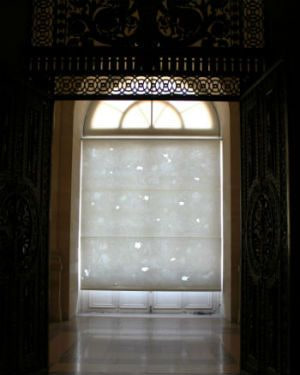
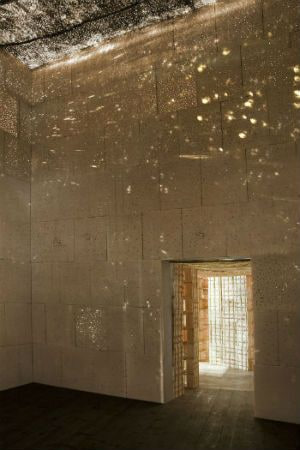
The recurring feature in the work of Dominique de Beir is the appearance of repetitive performative gestures. Dominique drills and digs into all sorts of "poor" surfaces (paper, cardboard, polystyrene) by means of sharp instruments (awls, scalpels, scales with points, hobnailed boots) originally borrowed from various business sectors, but today designed and realized by her to transcribe the effects of these instruments on different surfaces.
Knocking down the vocabulary of the painting (medium, material, color) by the randomness of movement, she tries to concentrate on notions of inscription and marking, between surface and depth, the physical impact, the density, the rhythm of which she investigates. Sometimes Dominique applies her performative energy until the limit of the material's resistance is reached. She plays on an ambiguity inherent to her movement between composition and destruction, opacity and transparency, stability and fragility.
The reliefs rendered by her performances share similarities to a kind of Braille which favor the more tactile perceptions rather than the purely optical. It is in the oppositions (opposite and its antagonisms; the violence of its action and the lightness of the delicacy of the result; the outside and inside; the visible and the hidden) that themselves show the subtleties of the work of the artist.
Her pictorial act often fundamentally draws upon Christian iconography, with recent exhibitions held in places of such religious belief (UK, France , Sicily) borrowing from Christ-like passion the assertions of the skinning, the alder of color and even the unction. She evokes Veronica, buckles and unveilings, raids, tears, eclipse, darkness. The artist taps, digs, crosses, reveals and replays the tearing of the veil, the skin. What is revealed to us, she leaves deliberately hollow, in depths and apertures. The Vera Icona, a recurrent theme in Apocrypha Gospels, penetrates the bottom of the texture up to the surface.


